Published: June 17, 2026
I'm Slava, founder of Jupid. Before this, I built Anna Money, where we worked with more than 60,000 small businesses. One pattern showed up again and again: a brand-new owner gets their EIN, glances at the confirmation letter, and clicks away or files it somewhere they'll never find again. Months later they're at a bank, or setting up payroll, or applying for a license, and someone asks for "the IRS EIN letter." That letter is the CP-575, and by then most people have lost it.
Here's the part that catches everyone off guard: the IRS issues the CP-575 exactly once. There's no "resend" button, no portal where you log in and download a fresh copy. If it's gone, it's gone. What you get instead is a different document called a 147C letter, which proves the same thing but takes a phone call and a wait.
None of this is complicated once you know how it works. The CP-575 is just a one-page confirmation that your business has an EIN, who it belongs to, and which tax returns the IRS expects from you. It's the document a bank, a payroll provider, or a state agency wants to see when they ask you to "verify your EIN."
This guide explains exactly what the CP-575 is, what's printed on it, what you'll use it for, why it's a one-time document, and what to do if yours is already missing. I'll keep it practical, because that's the only version of this that's useful when you're standing at a bank counter.
Here's what we'll cover:
- What the CP-575 is and what's printed on it
- What you'll use it for (bank accounts, payroll, licenses)
- Why the IRS issues it only once and won't reissue it
- The CP-575 vs. the 147C verification letter
- How to request a 147C if you lost your CP-575

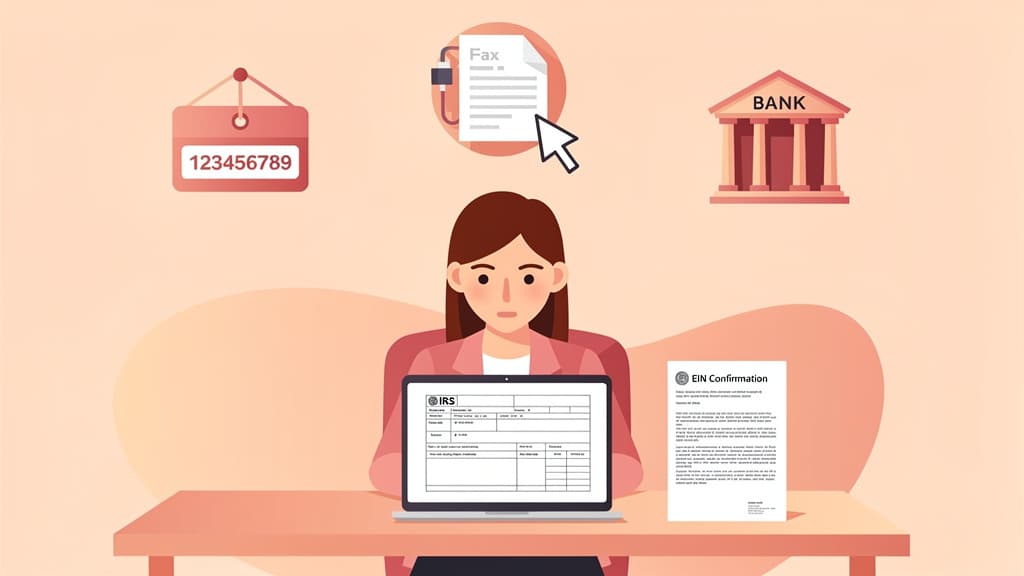
The CP-575 is the official notice the IRS sends to confirm that it assigned an Employer Identification Number (EIN) to your business. An EIN is the nine-digit federal tax ID for your company — the business equivalent of a Social Security number. When the IRS approves your EIN application (Form SS-4), it generates a CP-575 to confirm the number is now active and tied to your entity.
The "CP" stands for "computer paragraph," the IRS naming convention for automated notices, and 575 is just the specific notice number for EIN confirmations. You'll also see it called the "EIN confirmation letter" or "EIN assignment notice." They all mean the same document.
The format depends on how you applied. If you used the IRS online EIN application, the system issues your EIN immediately and shows you a CP-575 you can print or save as a PDF on the spot — there's a prompt to "print your EIN confirmation letter for your records." If you applied by fax or mail, the CP-575 arrives later as a physical letter (more on timing below). Either way, the content is the same.
For a fuller walkthrough of getting set up in the first place, see our guide on the EIN, registered agents, and what you need to start an LLC.
The CP-575 is short — usually one page — but every line on it matters because banks and agencies read it as proof. Here's what you'll find:
| Field on the CP-575 | What it means |
|---|
| Employer Identification Number | Your nine-digit EIN, formatted XX-XXXXXXX |
| Legal business name | The exact entity name from your Form SS-4 |
| Mailing address | The address the IRS has on file for the entity |
| Date the EIN was assigned | When your EIN became active |
| Forms you must file | The federal returns the IRS expects (e.g., Form 1120, 941, 940) |
| Filing requirements / due dates | Notes on which returns are due and roughly when |
The two fields people care about most are the EIN itself and the legal business name, because those have to match everywhere else — your bank application, your state registration, your payroll account. A mismatch as small as "LLC" vs. "L.L.C." or a missing comma can cause a bank or the IRS to reject a filing. Keep the exact spelling from your CP-575 and reuse it everywhere.
The "forms you must file" section is genuinely useful and most owners ignore it. It's the IRS telling you, in writing, which returns it's expecting from your entity type. If you formed an LLC taxed as an S corporation, for example, it flags the returns tied to that election. That preview is worth reading once so nothing surprises you at tax time. Our guide on staying tax compliant as an LLC breaks down what those filing obligations actually involve.
The CP-575 is the document third parties ask for when they want proof your EIN is real and belongs to you. The most common moments:
Opening a business bank account. Most banks require your EIN confirmation to open a business checking account, and many ask to see the CP-575 (or a 147C) specifically — not just the number typed on a form. They use it to match your legal name and EIN against what you give them. If you're at this stage, our guide on how to open a business bank account covers what else to bring.
Setting up payroll. Payroll providers and the IRS's employment-tax system are built around your EIN. When you onboard with a payroll service, they'll often request the CP-575 to confirm the EIN and legal name before they file employment taxes on your behalf.
Applying for business licenses and permits. State and local licensing agencies frequently ask for EIN proof. A business license, a sales tax permit, or a professional registration may all require a copy of your confirmation letter.
Applying for loans, credit, and merchant accounts. Lenders, business credit card issuers, and payment processors verify your EIN as part of underwriting and identity checks.
Vendor and contract onboarding. Larger clients sometimes ask new vendors to verify their EIN and legal name before paying invoices, especially when 1099 reporting is involved.
The through-line: anytime someone needs to confirm "this business is who it says it is, with this exact federal tax ID," the CP-575 is the cleanest proof you can hand over.
This is the rule that trips people up, so it's worth stating plainly: the IRS generates the CP-575 a single time, when your EIN is first assigned. It does not keep a stack of CP-575s to mail out on request, and there is no online account where you can re-download the original notice. Once you lose it, the IRS will not send you another CP-575.
That's not a glitch — it's how the system is built. The CP-575 is a one-time confirmation tied to the moment your EIN was created. After that, the IRS treats your EIN as established and points you to a different document, the 147C letter, whenever you need to re-verify the number later.
The practical takeaway is simple: save your CP-575 the moment you get it. If you applied online, download the PDF and print a copy before you close the browser window — the online tool shows it once. Store a digital copy somewhere you'll actually find it: a labeled folder in cloud storage, your accounting records, plus a printout in a physical file. Treat it like your formation documents, because functionally it's in the same tier of "papers you don't want to recreate."
If it's already too late and the original is gone, don't worry — that's exactly what the 147C is for.
These two letters confirm the same fact — that the IRS assigned a specific EIN to your business — but they are not the same document, and knowing which is which saves a lot of confusion at a bank counter.
| CP-575 | 147C |
|---|
| Official name | EIN Confirmation Letter | EIN Verification Letter |
| When you get it | Once, when your EIN is first assigned | Anytime later, on request |
| Can you request it again? | No — one-time only | Yes — request as many as you need |
| How to get it | Automatically, after your EIN application is approved | Call the IRS Business and Specialty Tax Line |
| Delivery | Online PDF (online applicants) or mailed letter | Faxed during the call, or mailed |
| Accepted as EIN proof? | Yes | Yes — banks and agencies accept it the same way |
The key point for everyday use: a bank, payroll provider, or licensing agency that asks for "your EIN letter" or "your CP-575" will accept a 147C just as readily. The 147C is the IRS's official replacement, not a lesser substitute. So if your CP-575 is lost, you are not stuck — you request a 147C and move on.
The IRS's own EIN guidance lists exactly two ways to confirm a previously assigned EIN: request an entity transcript, or call and ask for "Letter 147C, EIN Previously Assigned." Both prove the same number; the 147C is the one institutions usually want because it's a formatted letter on IRS letterhead.
If your CP-575 is gone, here's the process to get a 147C verification letter. It's a phone call, and only a person authorized for the business can make it.
1. Have your details ready. Before you call, pull up your nine-digit EIN (if you have it) and the exact legal business name as it appears on your records. The representative uses these to find your account. If you've genuinely lost the EIN too, first check the places the IRS suggests: any prior IRS notice, your bank, a state licensing agency, or a previously filed tax return. Our guide on how to find your EIN number walks through every place to look before you call.
2. Call the IRS Business and Specialty Tax Line at 800-829-4933. It's open Monday through Friday, 7 a.m. to 7 p.m. your local time. This is the same line that issues new EINs, so it's the right department for EIN questions.
3. Verify your identity. The representative will confirm you're authorized to receive the EIN for the entity — typically an owner, officer, partner, or someone with proper authorization on file. They will not give the number or letter to just anyone who calls.
4. Ask specifically for "Letter 147C." Using the exact name avoids back-and-forth. Tell them you need the 147C EIN verification letter because your CP-575 was lost.
5. Choose fax or mail. The IRS can fax the 147C to you during the same call, which is the fast route — you can have it in hand in minutes if you have a fax number (many businesses use an online fax service for exactly this). If you ask for it by mail instead, plan on roughly four to six weeks for delivery.
Here's how the timing compares across every EIN document path:
Getting your EIN document — typical turnaround
-----------------------------------------------
Apply for EIN online .................. EIN + CP-575 issued immediately (print it)
Apply for EIN by fax .................. about 4 business days
Apply for EIN by mail ................. about 4 weeks
Request 147C by fax (phone call) ...... same call, often minutes
Request 147C by mail .................. about 4 to 6 weeks

Example: lost your CP-575, need proof for a bank Monday
  - Call 800-829-4933 Friday morning, verify identity
  - Ask for Letter 147C, request it by fax
  - Receive 147C the same day -> bank is satisfied Monday
One caution worth flagging: only the IRS issues a valid 147C, and only over the phone (faxed or mailed) after identity verification. Be skeptical of any third-party website that offers to "instantly download your CP-575 or 147C" for a fee. The genuine documents come from the IRS directly, and re-verifying your own EIN is free.
Not saving the CP-575 when you apply online. The online EIN tool shows the confirmation once. People click through, assume they'll get it in the mail, and never do. Download the PDF and print it before closing the window.
Assuming the IRS will resend the original. It won't. There is no reissue of the CP-575. If yours is lost, the answer is always a 147C, not a duplicate CP-575. Stop hunting for a "resend" option that doesn't exist.
Letting the legal name drift. If your bank, your state registration, and your CP-575 don't all show the exact same legal name, you'll hit rejections. Copy the name verbatim from the CP-575 and reuse it everywhere.
Waiting until the last minute. If you need EIN proof for a Friday closing or a Monday bank appointment, don't call the IRS that morning hoping for a mailed letter. Request the 147C by fax for a same-day copy, or build in four to six weeks if you go by mail.
Calling without authorization. The IRS only releases the EIN and 147C to someone authorized for the business. If you're not the owner or an officer, make sure you have proper authorization on file before you call, or you'll be turned away.
Most of the pain around the CP-575 comes from one thing: it's a document you need rarely, so it's easy to misplace until the exact moment it matters. Jupid is an AI accountant that lives in WhatsApp and iMessage, and it's built to keep your business's financial life organized so the next "where's that document?" scramble doesn't derail your day.
Connect your bank account and Jupid pulls in your transactions and auto-categorizes each one with 95.9% accuracy, so your books stay current without manual upkeep. Over time it learns how your business categorizes spending and applies the right account automatically — you can read more about that in transaction learning. When something's ambiguous, you settle it in a quick chat message instead of opening a spreadsheet.
The benefit when situations like a 147C request come up is real: your records are already in order, your legal name and EIN are consistent across your books, and you can ask Jupid for the numbers a lender or bank wants — "what was my revenue last quarter?" — and get an answer in chat in seconds. Jupid also handles automatic tax filing built on numbers that already match your accounts, so the filing requirements listed on your CP-575 are handled in the background.
A clean set of books shouldn't depend on you remembering where one IRS letter went. Try Jupid and let the day-to-day bookkeeping run itself.
This guide is for general educational purposes and does not constitute tax, legal, or accounting advice. IRS procedures, phone numbers, and processing times can change. Verify details with the IRS directly and consult a qualified tax professional before relying on any document for a filing or financial application.