

Tax PlanningMar 4, 2026
Wash Sale Rule 2026: How the 61-Day Window Works and How to Avoid It
The wash sale rule blocks your capital loss deduction if you rebuy the same security within 30 days. Here's how the 61-day window works in 2026.
Read more
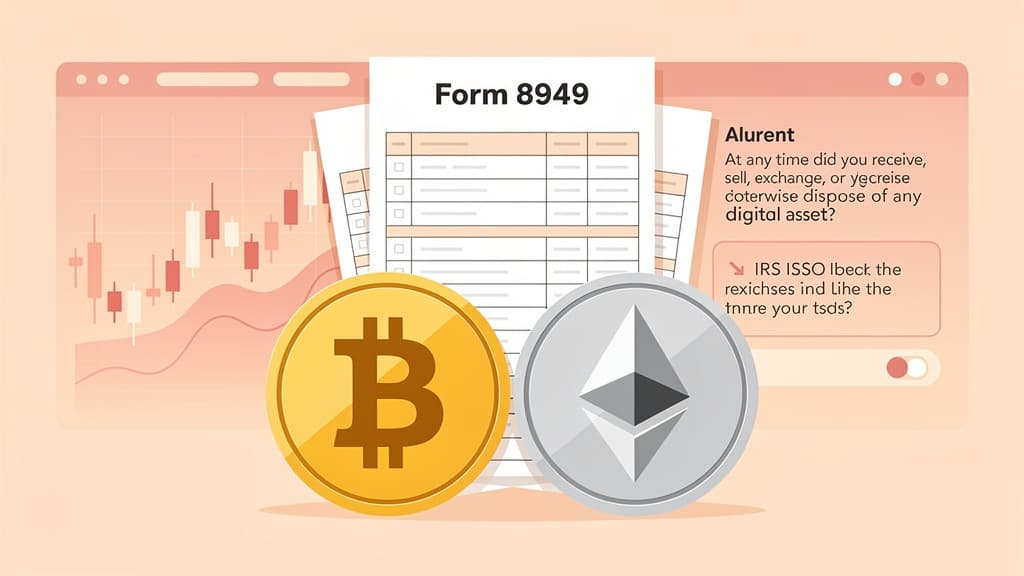
Crypto capital gains tax for 2026 works like stock: coins held over one year are taxed at long-term rates of 0%, 15%, or 20% (the 0% rate covers taxable income up to $49,450 single / $98,900 married filing jointly), and coins held one year or less are taxed at ordinary rates of 10%-37%. The two biggest crypto tax changes for 2026: exchanges now report your cost basis on Form 1099-DA for assets acquired on or after January 1, 2026, and gifting crypto remains tax-free up to $19,000 per recipient.
Key takeaways:

Four changes matter for 2026 filings:
Since IRS Notice 2014-21, all "virtual currency" (now called "digital assets") is treated as property for federal tax purposes. This means:
This property classification applies to all digital assets: Bitcoin, Ethereum, stablecoins, altcoins, tokens, NFTs, and wrapped tokens.
Since 2019, the IRS has included a question on the front page of Form 1040 asking whether you received, sold, exchanged, or otherwise disposed of digital assets during the tax year. For 2026, the question reads:
"At any time during 2026, did you: (a) receive (as a reward, award, or payment for property or services); or (b) sell, exchange, or otherwise dispose of a digital asset (or a financial interest in a digital asset)?"
You must answer "Yes" if you had any taxable crypto activity. Answering "No" when the IRS has 1099-DA forms showing otherwise is a red flag for audit.
When you can answer "No": If you only held crypto in an account and did not sell, trade, receive, or spend any of it during the year.
| Event | Tax Treatment | Reported On |
|---|---|---|
| Selling crypto for cash (USD, EUR, etc.) | Capital gain/loss | Form 8949 + Schedule D |
| Trading crypto-to-crypto (BTC → ETH) | Capital gain/loss on disposed asset | Form 8949 + Schedule D |
| Spending crypto on purchases | Capital gain/loss at fair market value | Form 8949 + Schedule D |
| Receiving crypto as payment for services | Ordinary income at FMV when received | Schedule C (self-employed) or Schedule 1 |
| Mining income | Ordinary income at FMV when received | Schedule C (if business activity) |
| Staking rewards | Ordinary income at FMV when received | Schedule C or Schedule 1 |
| Airdrops (with dominion and control) | Ordinary income at FMV when received | Schedule 1 or Schedule C |
| Hard fork resulting in new coins you control | Ordinary income at FMV when received | Schedule 1 or Schedule C |
| Selling an NFT | Capital gain/loss (potentially collectible rate) | Form 8949 + Schedule D |
| Event | Why It's Not Taxable |
|---|---|
| Buying crypto with USD | No gain or loss realized; this establishes your cost basis |
| Transferring crypto between your own wallets | No change of ownership; not a disposition |
| Gifting crypto (up to $19,000 per recipient in 2026) | Annual gift exclusion applies; recipient inherits your cost basis |
| Donating crypto to a qualified charity | Charitable deduction at FMV (if held over 1 year); no capital gains |
| Holding crypto without selling | Unrealized gains are not taxed |
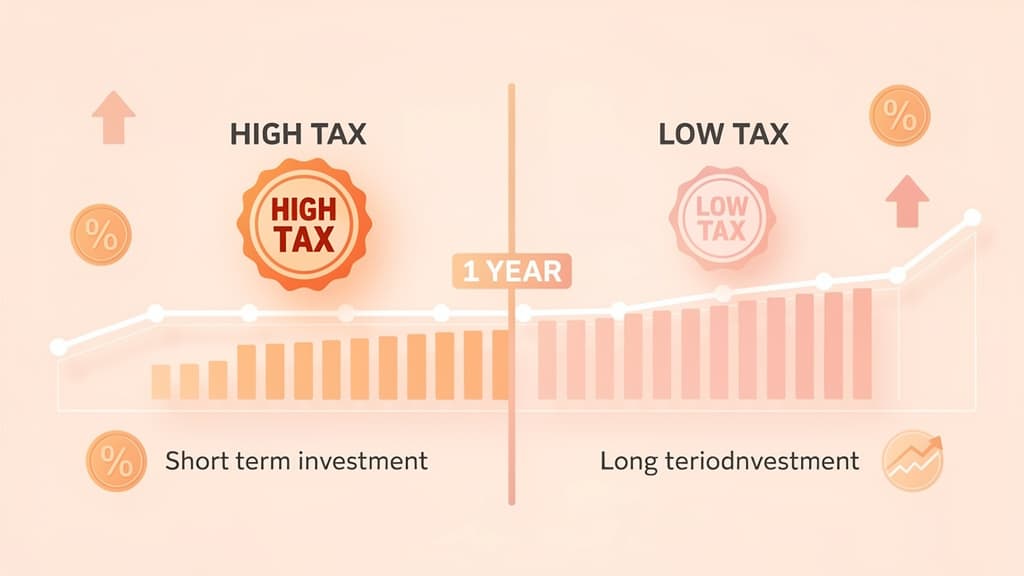
The holding period determines your tax rate.
Short-term (held 1 year or less): Taxed at your ordinary income tax rate. For 2026, that's 10% to 37% depending on your total taxable income.
Long-term (held over 1 year): Taxed at preferential capital gains rates. The 2026 breakpoints (Rev. Proc. 2025-32, by taxable income):
| Filing Status | 0% Rate | 15% Rate | 20% Rate |
|---|---|---|---|
| Single | $0 - $49,450 | $49,451 - $545,500 | Over $545,500 |
| Married Filing Jointly | $0 - $98,900 | $98,901 - $613,700 | Over $613,700 |
High earners also owe the 3.8% Net Investment Income Tax (NIIT) on crypto gains once modified AGI exceeds $200,000 (single) or $250,000 (MFJ). For the full holding-period rules, see our short-term vs long-term capital gains guide.
NFTs classified as collectibles: The IRS clarified in Notice 2023-27 that certain NFTs may be treated as "collectibles" under IRC §408(m). Collectibles held over one year are taxed at a maximum rate of 28%, higher than the standard 20% cap.
The formula: sale proceeds minus cost basis (what you paid, including acquisition fees) equals your capital gain or loss.
Worked example, long-term gain: You bought 1 BTC on January 15, 2025 for $42,000 plus a $50 exchange fee (cost basis $42,050). You sold it on March 1, 2026 for $68,000 minus a $50 fee (proceeds $67,950). Capital gain: $67,950 - $42,050 = $25,900, long-term because you held over 12 months.
Worked example, crypto-to-crypto trade: You bought 10 ETH on November 1, 2025 for $32,000. On February 15, 2026 you traded the 10 ETH for 0.5 BTC worth $35,000. That trade is a sale of ETH: proceeds $35,000, basis $32,000, short-term gain $3,000. Your new cost basis in the 0.5 BTC is $35,000.
Run your own numbers in our Crypto Tax Calculator.
The IRS allows two primary methods for determining which units you're selling:
FIFO (First In, First Out): The default method. Your oldest units are sold first. This typically results in long-term gains if you've held crypto for a while.
Specific Identification: You choose exactly which units to sell. This gives you the most control over your tax outcome: you can select high-cost-basis lots to minimize gains or select loss lots for tax-loss harvesting.
Per-wallet tracking (since January 1, 2025): The IRS eliminated the "universal" method that pooled assets across all wallets and exchanges. Cost basis must be tracked per wallet or per account, and when you move coins between wallets, the basis of those specific units moves with them.
Giving crypto is not a taxable disposition: no capital gains for the giver, no income for the recipient. For 2026, gifts up to $19,000 per recipient (the annual exclusion) require no reporting at all. Above $19,000 to any one person, the giver files Form 709 (gift tax return, due April 15 of the following year), but actual gift tax is rare because amounts above the exclusion simply reduce your $15 million lifetime estate and gift exclusion (2026, set by the One Big Beautiful Bill Act). Married couples can jointly give $38,000 per recipient.
What the recipient inherits:
Worked example: Dan bought 0.25 BTC for $10,000 in 2023 and gifts it to his sister in March 2026 when it's worth $17,000. Nobody reports anything: it's under $19,000. His sister's basis is $10,000 with a 2023 holding period. If she sells in 2027 for $20,000, she reports a $10,000 long-term capital gain on Form 8949.
Clear reporting for gift transfers: Exchanges have no "gift" transaction type, so a gifted transfer can look identical to a normal withdrawal in your records. Document the date, the recipient, the fair market value on the transfer date, and your original basis in a written gift letter; the recipient needs those numbers to file correctly when they eventually sell. Estimate any Form 709 exposure with our Gift Tax Calculator.
If you're a freelancer or self-employed individual who accepts crypto as payment, the fair market value at the time you receive it is ordinary income reported on Schedule C. This income is subject to both income tax and the 15.3% self-employment tax.
Worked example: A client pays you 0.5 ETH for a web design project in March 2026, worth $1,800 on receipt. You report $1,800 on Schedule C and owe SE tax of $1,800 × 92.35% × 15.3% = $254. Your cost basis in the ETH is $1,800; if you later sell it for $2,200, you also report a $400 capital gain on Form 8949.
If you mine cryptocurrency, the IRS treats mined coins as ordinary income at fair market value when you receive them (when the coins are credited to your wallet and you have dominion and control).
Most active miners should report on Schedule C. The IRS looks at factors like regularity, profit motive, and investment in equipment to distinguish business from hobby activity.
Staking rewards are taxable as ordinary income at the fair market value when you receive them, confirmed by IRS guidance and reinforced by case law in Jarrett v. United States (although the case was mooted, the IRS position remains clear).
When is staking income "received"? When you have dominion and control: typically when the rewards appear in your wallet and you can sell or transfer them.
Worked example: You stake 32 ETH and earn 1.6 ETH in rewards during 2026, worth $5,760 across the payout dates. You report $5,760 as ordinary income, and your cost basis in the 1.6 ETH is $5,760.
Per Rev. Rul. 2019-24, if you receive new cryptocurrency from an airdrop or hard fork, it's ordinary income at the fair market value when you have dominion and control over the new coins. Your cost basis in the received tokens equals the FMV at the time of receipt.
Every individual crypto sale, trade, or spending event gets its own line on Form 8949. You'll need:
Form 8949 has six reporting boxes; pick the one that matches your 1099-DA situation:
| Box | Situation | Description |
|---|---|---|
| A | Short-term, basis reported to IRS | Broker sent 1099-DA with basis (sales of assets acquired on/after 1/1/2026) |
| B | Short-term, basis NOT reported to IRS | 1099-DA shows proceeds but no basis |
| C | Short-term, no 1099-DA received | Self-custody trades, DeFi swaps |
| D | Long-term, basis reported to IRS | Same as A but held over 1 year |
| E | Long-term, basis NOT reported to IRS | Same as B but held over 1 year |
| F | Long-term, no 1099-DA received | Same as C but held over 1 year |
Schedule D summarizes your Form 8949 totals:
If your crypto losses exceed your gains, you can deduct up to $3,000 per year ($1,500 if married filing separately) against ordinary income. Unused losses carry forward to future tax years indefinitely.
Form 1099-DA (Digital Asset Proceeds from Broker Transactions) is the crypto-specific version of Form 1099-B. Starting with transactions in 2025, centralized exchanges and custodial brokers must report your digital asset sales to the IRS.
For the 2026 tax year, Form 1099-DA includes:
| Field | 2025 Transactions | 2026 Transactions |
|---|---|---|
| Gross proceeds | Yes | Yes |
| Cost basis | No (not required) | Yes (for covered assets acquired on/after 1/1/2026) |
| Date acquired | No | Yes (for covered assets) |
| Date sold | Yes | Yes |
| Short-term/long-term | No | Yes (for covered assets) |
"Covered" vs. "noncovered" digital assets:
For noncovered assets, you must provide your own cost basis on Form 8949.
Since January 1, 2025, cost basis is tracked per wallet or per account (Rev. Proc. 2024-28). The previous "universal" method, which treated all your Bitcoin across every exchange and wallet as one combined pool, is gone. Here is what that changes:
| Location | Holdings | Basis per BTC |
|---|---|---|
| Coinbase | 2 BTC | $30,000 |
| Kraken | 1 BTC | $50,000 |
| Hardware wallet (transferred from Coinbase) | 0.5 BTC | $30,000 (basis follows the transfer) |
Under the old universal method, all 3.5 BTC shared an average basis around $34,286. Under per-wallet rules, selling 1 BTC from Kraken uses the $50,000 basis while selling 1 BTC from Coinbase uses $30,000. Same sale price, different taxable gains.
Form 1099-DA only applies to transactions on custodial broker platforms (centralized exchanges). After Congress repealed the DeFi broker rule in April 2025, the following are NOT reported on 1099-DA:
You are still required to report all taxable events from these activities on Form 8949. You just won't have a 1099-DA to match against.
DeFi transactions create complex tax situations because most involve multiple taxable events:
Liquidity pool deposits: Depositing tokens into a liquidity pool (like Uniswap) is generally treated as a taxable swap: you're exchanging your tokens for LP tokens, which triggers a capital gain or loss on the deposited assets.
Yield farming rewards: Tokens earned from yield farming are ordinary income at fair market value when received. When you later sell those tokens, any change in value creates a capital gain or loss.
Lending interest (DeFi lending): Interest earned from lending protocols (Aave, Compound) is ordinary income when received.
Wrapping and unwrapping: Wrapping ETH to WETH may or may not be a taxable event; the IRS has not provided definitive guidance. Conservative tax treatment would recognize this as a disposition.
Creating and selling an NFT: If you create and sell an NFT, the proceeds are ordinary income (potentially on Schedule C if it's a business activity). Costs of creation are deductible.
Buying and selling an NFT: This is a capital transaction reported on Form 8949. The IRS has indicated that certain NFTs may be classified as "collectibles" under IRC §408(m), potentially subject to the higher 28% long-term capital gains rate.
Royalties from NFT resales: Ongoing royalties received when your NFT is resold are ordinary income.
Trading stablecoins (USDC, USDT) for other crypto or cashing them out is technically a taxable event. However, if you bought USDC at $1.00 and sold it at $1.00, the gain is $0. You still need to report the transaction on Form 8949, but there's no tax due.
The exception: if a stablecoin depegged and you bought at $0.95 and redeemed at $1.00, you have a $0.05-per-unit capital gain.
Tax-loss harvesting means selling crypto at a loss to offset gains from other sales. Unlike stocks, crypto is not subject to the wash sale rule under current law (as of 2026), because the rule in IRC §1091 covers "securities" and crypto is property. This means you can:
Worked example: You bought 1 BTC at $65,000 and it drops to $52,000. You sell (realizing a $13,000 loss) and immediately rebuy at $52,000. You keep your Bitcoin position, claim the $13,000 loss, and your new basis is $52,000. With stock, the wash sale rule would disallow that loss.
Warning: Congress has repeatedly proposed extending the wash sale rule to crypto. For 2026 the exemption remains in place, but document your transactions carefully.
Crypto losses offset gains in this order:
Estimate the payoff with our Capital Gains Tax Calculator.
Every crypto-to-crypto trade is a taxable event. Trading BTC for ETH is a sale of BTC, and you owe capital gains tax on any appreciation since you acquired the BTC.
If you transferred 1 BTC from Coinbase to a hardware wallet, your cost basis doesn't reset. The basis from the original purchase follows the asset. Under per-wallet rules, document every transfer.
Staking rewards and mined coins are ordinary income when received. Even if you don't sell them, you owe income tax at the fair market value on the date of receipt.
Answering "No" to the digital asset question when you have taxable activity is a misstatement on a federal return. The IRS now receives 1099-DA data and can easily verify.
Without accurate cost basis records, you cannot calculate your gains correctly. The IRS default if you have no basis records is $0, meaning 100% of your proceeds would be taxed as gain.
While DeFi transactions don't appear on 1099-DA, blockchain transactions are public and traceable. The IRS has contracts with blockchain analytics firms (Chainalysis, CipherTrace) that can link wallet addresses to individuals.
If clients pay you in crypto, that income lands on Schedule C next to your regular invoices, and Jupid keeps the whole picture straight. Jupid is an AI accountant in WhatsApp and iMessage: connect your bank account and it categorizes business transactions with 95.9% accuracy, tracks your running profit, and answers questions like "How much do I owe in self-employment tax this quarter?" in real time. Jupid doesn't replace dedicated portfolio software for heavy trading, but it keeps the business-income side of your crypto life filing-ready.
| Item | 2026 Amount |
|---|---|
| Short-term capital gains rate | 10%-37% (ordinary rates) |
| Long-term capital gains rate (single) | 0% to $49,450; 15% to $545,500; 20% above |
| Collectibles (NFT) max rate | 28% |
| Net capital loss deduction limit | $3,000/year |
| Net investment income tax (NIIT) | 3.8% (over $200K single / $250K MFJ) |
| SE tax on crypto business income | 15.3% |
| Annual gift tax exclusion | $19,000 per recipient |
| Lifetime estate and gift exclusion | $15,000,000 |
| 1099-DA cost basis reporting starts | January 1, 2026 acquisitions |
| Per-wallet basis tracking required since | January 1, 2025 |
Disclaimer
This article provides general information about cryptocurrency taxation and should not be considered tax advice. Digital asset tax rules are evolving rapidly, and IRS guidance continues to develop. Your actual tax liability depends on your specific transactions, holding periods, cost basis, income level, and filing status. For complex crypto portfolios or DeFi activity, consult with a tax professional experienced in digital asset taxation.
Tax Year: 2026 Last Updated: July 7, 2026

CEO & Co-Founder
Fintech CEO with 10+ years building accounting and financial technology products. Previously co-founded and scaled an AI-powered accounting platform to $30M revenue and 100K+ business users, achieving 30,000 customers per accountant through automation — recognized by CNBC as a top fintech company. Holds a Master's in Management Information Systems. At Jupid, he leads the development of AI-native bookkeeping, tax, and compliance tools designed for freelancers and small business owners.
The wash sale rule blocks your capital loss deduction if you rebuy the same security within 30 days. Here's how the 61-day window works in 2026.
Short-term vs long-term capital gains tax rates for 2026: holding period rules, rate thresholds, NIIT, netting rules, and strategies to reduce your tax bill.

How dividends are taxed in 2026: qualified vs ordinary rates, holding period rules, S-corp distributions, NIIT, and reporting on your tax return.
New here? Enter this code at checkout and your first month is on us — full AI bookkeeping, tax filing, and a 24/7 accountant, $0 for 30 days.
New customers. First month free with code NEW2026, cancel anytime.
Join 1,000+ businesses using Jupid to save time and money. Start simplifying your finances today.
30-day money-back guarantee