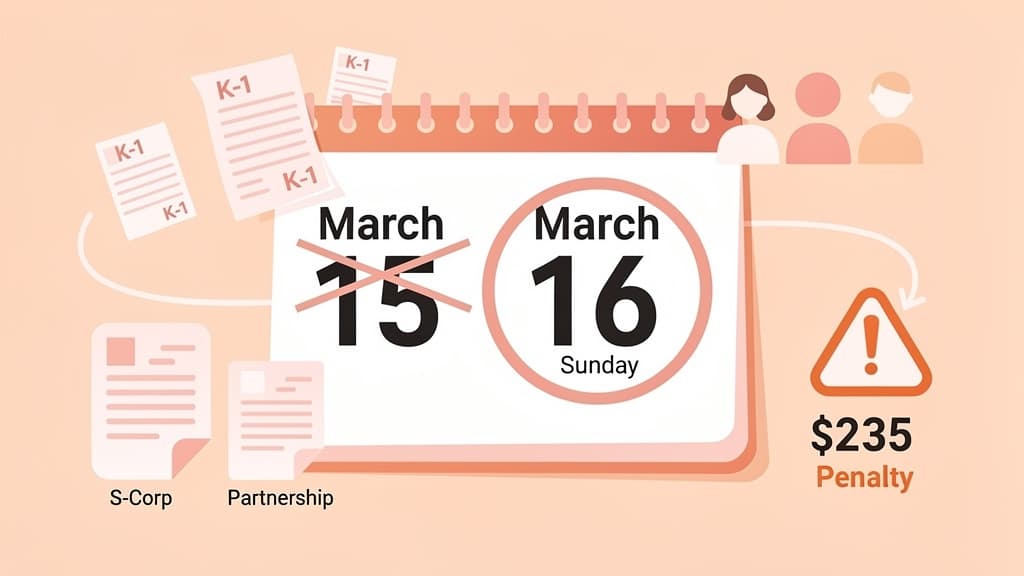
Form 1065 (partnerships and multi-member LLCs) and Form 1120-S (S corporations) for tax year 2025 were due March 16, 2026. The statutory deadline is March 15, but it fell on a Sunday, and IRC §7503 moves a weekend deadline to the next business day. That deadline has passed. If you filed Form 7004 on time, your extended filing deadline is September 15, 2026. If you missed it entirely, the IRS charges $255 per partner or shareholder for each month the return is late, and filing now is what stops the meter.
Key takeaways:
- Form 1065 and Form 1120-S are due the 15th day of the 3rd month after the tax year ends (IRC §6072(b)): March 16, 2026 for calendar-year 2025 returns
- Extended returns (Form 7004 filed by March 16) are due September 15, 2026
- The late-filing penalty is $255 per partner or shareholder per month, up to 12 months, even if the entity owes zero tax
- First-time penalty abatement can erase the penalty if your prior 3 years of filings are clean
- A missed Form 2553 S-Corp election can often be fixed with late-election relief under Rev. Proc. 2013-30
| What's Due | Form | 2026 Deadline | Who It Applies To |
|---|
| S-Corp tax return | Form 1120-S | March 16 | S-Corporations |
| Partnership tax return | Form 1065 | March 16 | Partnerships & multi-member LLCs |
| Schedule K-1 distribution | K-1 (from 1120-S or 1065) | March 16 | Issued to shareholders/partners |
| Extension request | Form 7004 | March 16 | Extends filing to Sep 15 |
| S-Corp election | Form 2553 | March 16 | New S-Corp elections for 2026 |
Legal basis: IRC §6072(b), IRC §6698, IRC §7503

March 15 is not an arbitrary date. S-Corps and partnerships are pass-through entities: they don't pay federal income tax themselves. Instead, income passes through to shareholders and partners, who report it on their personal tax returns via Schedule K-1.
The IRS set the entity return deadline one month before the April 15 individual deadline for a specific reason: to give shareholders and partners time to receive their K-1s and incorporate that information into their personal returns. Without that buffer, individual filers would be waiting on entity returns that aren't even due until their own filing deadline.
This is the core of the March 15 deadline: a sequencing mechanism, not just an administrative date.
Under IRC §7503, when a tax deadline falls on a Saturday, Sunday, or legal holiday, the deadline moves to the next business day. March 15, 2026, is a Sunday, so all March 15 deadlines shifted to Monday, March 16, 2026.
This applies to Form 1120-S, Form 1065, Schedule K-1 distribution, Form 7004 extensions, and Form 2553 elections — everything that would normally be due March 15.
Form 1120-S is due the 15th day of the 3rd month after the end of the S corporation's tax year, per IRC §6072(b). For calendar-year S corporations, that was March 16, 2026. If you have not filed and did not extend, file now: the $255 per-shareholder monthly penalty is already running.
- Income and deductions: gross receipts, cost of goods sold, ordinary business income, deductions for salaries, rent, depreciation, and other business expenses
- Schedule K: the S-Corp's total income, deductions, and credits allocated to shareholders
- Schedule K-1: each shareholder's individual share of income, deductions, credits, and distributions
- Balance sheet (Schedule L): assets, liabilities, and equity at year-end
- Shareholder basis information: distributions, contributions, and retained earnings
Form 1120-S generates a Schedule K-1 for each shareholder. These K-1s report the shareholder's pro-rata share of income, losses, deductions, and credits. Shareholders use this information to complete their personal Form 1040, typically due April 15.
S-Corp shareholders who perform services for the corporation must pay themselves a reasonable salary before taking distributions. The IRS scrutinizes S-Corps that pay little or no salary while distributing significant profits — because salary is subject to payroll taxes, while distributions are not.
If you're an S-Corp owner, use the S-Corp Salary Calculator to determine an appropriate salary based on your role and industry.
For a complete guide to S-Corp deadlines and filing requirements, see S-Corp Tax Deadlines 2026.
Form 1065 is due the 15th day of the 3rd month after the end of the partnership's tax year. Partnerships and multi-member LLCs (taxed as partnerships by default) had until March 16, 2026 to file for tax year 2025, or until September 15, 2026 with a Form 7004 extension.
- Ordinary business income or loss: revenue minus deductible expenses
- Schedule K: the partnership's total allocable items (income, deductions, credits, self-employment earnings)
- Schedule K-1: each partner's distributive share of all allocable items
- Capital account reporting: each partner's beginning balance, contributions, distributions, share of income/loss, and ending balance (reported on Schedule K-1, Part II, Item L)
- Balance sheet (Schedule L): partnership assets, liabilities, and capital
Each partner receives a Schedule K-1 (Form 1065) showing their share of partnership income. Partners use this to complete their individual returns. For partnerships with many partners, generating accurate K-1s can be time-intensive — another reason the March 15 deadline is set a month before April 15.
For detailed guidance on partnership filing, see Partnership Tax Deadlines: Form 1065 Guide and Schedule K-1 Guide.
This is the part that causes the most real-world problems. The March 15 deadline isn't just about the entity return — it triggers a chain of dependent filings.
Here's how the cascade works:
- Entity return filed by March 16 → K-1s generated and distributed to shareholders/partners
- Shareholders/partners receive K-1s → incorporate K-1 information into their personal returns
- Individual returns filed by April 15 → includes K-1 income from all pass-through entities
When the entity return is late, K-1s are delayed. When K-1s are delayed, shareholders and partners can't complete their personal returns. They have two options: file a personal extension (Form 4868) and wait, or file their personal return without the K-1 and amend later. Neither is ideal.
For multi-entity owners (someone who's a partner in one LLC and a shareholder in another S-Corp), a single late entity return can hold up their entire personal filing. This is why the $255-per-month penalty exists: the IRS wants to create a strong incentive for timely entity filings so downstream filers aren't left waiting.
If you couldn't file by March 16, Form 7004 provides an automatic 6-month extension — moving the filing deadline to September 15, 2026.
- File Form 7004 by the original deadline (March 16)
- The extension is automatic: no explanation or approval needed
- The extended deadline is September 15 for both S-Corps (Form 1120-S) and partnerships (Form 1065)
- The window to request this extension closed on March 16, 2026; Form 7004 cannot be filed retroactively
Filing an extension solves the penalty problem for the entity return, but it does not solve the K-1 problem. When an S-Corp or partnership files an extension, K-1s won't be issued until the return is actually filed, potentially as late as September 15.
That means shareholders and partners will likely need to file their own personal extensions (Form 4868, extending to October 15) to wait for K-1s. The cascade effect still applies; it's just delayed by six months.
Form 2553, the S-Corp election form, was also due March 16, 2026, for calendar-year entities wanting to elect S-Corp status effective January 1, 2026.
Under IRC §1362(b), the election must be filed within 2 months and 15 days after the beginning of the tax year the election is to take effect. That is the IRS's phrasing of the 15th-day-of-the-3rd-month rule: March 15 for calendar-year entities. Since March 15 was a Sunday in 2026, the deadline moved to March 16.
If you missed this deadline, late election relief may be available under Rev. Proc. 2013-30. You'll need to demonstrate reasonable cause, show that you have filed consistently with the intended election, and attach the required statements to a late-filed Form 2553. Consult a tax professional if this applies to your situation.
The penalty for late filing of Form 1120-S or Form 1065 is not based on the amount of tax owed (pass-through entities generally don't owe entity-level tax). Instead, it's based on the number of shareholders or partners.
$255 per shareholder or partner, per month (or partial month) the return is late, for up to 12 months.
This penalty applies under IRC §6698 (partnerships) and IRC §6699 (S-Corps). The amount is inflation-adjusted annually: $255 is the rate for returns required to be filed in 2026, confirmed in IRS notice CP162 guidance. The "per month" clock starts the day after the deadline and runs until the return is filed.
| Scenario | Calculation | Total Penalty |
|---|
| 2-person S-Corp, 3 months late | 2 × $255 × 3 | $1,530 |
| 3-partner LLC, 1 month late | 3 × $255 × 1 | $765 |
| 5-partner LLC, 2 months late | 5 × $255 × 2 | $2,550 |
| 10-partner LLC, 6 months late | 10 × $255 × 6 | $15,300 |
These penalties add up quickly for entities with multiple owners. A 10-partner firm that files six months late faces $15,300 in penalties, even though the return itself may show zero tax due at the entity level.
If your S-Corp or partnership return is past due, take action now. Every month you wait adds another round of penalties.
The penalty is calculated per month or partial month. Filing today stops the clock. Even if you're only a few days into a new penalty month, filing immediately prevents another full month from accruing.
Worked example (filing in July 2026): a 2-partner LLC that files its 2025 Form 1065 on July 10, 2026 without an extension is 4 partial months late (March 17 through July 10). The penalty: 2 partners × $255 × 4 months = $2,040. Waiting until mid-August adds a fifth month and another $510.
When you file late, include a statement explaining the reason for the delay. The IRS may waive the penalty if you demonstrate reasonable cause: circumstances beyond your control that prevented timely filing.
Examples of reasonable cause the IRS may accept:
- Serious illness or death of the taxpayer, a family member, or the tax preparer
- Destruction of records by fire, flood, or other casualty
- Inability to obtain necessary records (e.g., waiting on third-party information)
- Reliance on incorrect professional advice
Attach a written explanation to the late return, or file a penalty abatement request using Form 843 or a written letter.
If you have a clean compliance history, meaning you filed on time and paid on time for the three prior tax years, you may qualify for first-time penalty abatement. This is an administrative waiver that doesn't require proving reasonable cause.
To request FTA:
- Call the IRS at the number on your penalty notice
- Or submit a written request referencing IRM 20.1.1.3.6.1
FTA is one of the most underused penalty relief tools available to small businesses.
If the penalty amount is significant and you can't pay it all at once, you can request a payment plan with the IRS.
Not every business entity is subject to the March 15 deadline. Here's who files later.
| Entity Type | Form | Deadline | Extension To |
|---|
| S-Corporation | 1120-S | March 16 | September 15 |
| Partnership | 1065 | March 16 | September 15 |
| Multi-member LLC | 1065 | March 16 | September 15 |
| Sole proprietor | Schedule C (1040) | April 15 | October 15 |
| Single-member LLC | Schedule C (1040) | April 15 | October 15 |
| C-Corporation | 1120 | April 15 | October 15 |
| Individual | 1040 | April 15 | October 15 |
The pattern is straightforward: pass-through entities with multiple owners file March 15 (March 16 in 2026). Everyone else files April 15.
Sole proprietors and single-member LLCs report business income on Schedule C attached to their personal Form 1040, following the individual April 15 deadline. C-Corporations file Form 1120 by the 15th day of the 4th month after the end of the tax year: April 15, 2026 for calendar-year corporations, extendable to October 15, 2026 with Form 7004.
For a complete calendar of all business tax deadlines, see the Tax Deadline Calendar.
The statutory deadline is March 15, but because March 15, 2026, fell on a Sunday, the actual deadline was March 16. Business owners who set calendar reminders for "March 15" and took no action over the weekend may have assumed they missed it, or may not have realized the shift gave them an extra day.
Filing Form 7004 extends the entity filing deadline to September 15, but it does not create an obligation to deliver K-1s by any specific earlier date. K-1s are generated when the return is prepared. If you file on extension and don't prepare the return until September, your shareholders or partners won't have their K-1s until then, and they'll likely need personal extensions too.
Many small business owners pay the late-filing penalty without realizing they can request relief. Reasonable cause abatement and first-time penalty abatement are both available, and the IRS grants them regularly. If you filed late for a legitimate reason, or if your compliance history is clean, request abatement before paying the penalty.
An LLC that wants to be taxed as an S-Corp must file Form 2553 with the IRS. Without an accepted 2553 election, the entity is still treated as a partnership (if multi-member) or disregarded entity (if single-member). Filing Form 1120-S without a valid election on file can result in the return being rejected. If you also missed the Form 1065 deadline while filing the wrong form, the $255 per-partner monthly penalty applies on top.
Always confirm your entity's tax classification with the IRS before filing. If you elected S-Corp status, you should have a copy of your accepted Form 2553 or IRS Letter 385C confirming the election.
If your entity return is on extension, the work between now and September 15, 2026 is bookkeeping. Jupid connects to your business bank accounts and categorizes every transaction with 95.9% accuracy, so the income and expense totals that Form 1120-S or Form 1065 require are ready before your preparer asks for them. Jupid's AI accountant answers questions in WhatsApp or iMessage in real time: ask "What was my business income in 2025?" and you get the number, not a spreadsheet export. Try Jupid.
- IRC §6072(b) — Time for filing returns of partnerships and S-Corps (15th day of 3rd month)
- IRC §6698: failure to file partnership return penalty ($255/partner/month for returns filed in 2026)
- IRC §6699: failure to file S-Corp return penalty ($255/shareholder/month for returns filed in 2026)
- IRC §7503 — Deadline postponement when due date falls on Saturday, Sunday, or holiday
- IRC §1362(b) — S-Corp election timing (Form 2553 due by 15th day of 3rd month)
| Item | 2026 Amount |
|---|
| Late filing penalty (S-Corp/Partnership) | $255 per shareholder/partner per month |
| Maximum penalty duration | 12 months |
| March 15 deadline (actual) | March 16 (Sunday shift) |
| Extension deadline | September 15, 2026 |
| S-Corp election deadline (Form 2553) | March 16, 2026 |
March 15 is the most important tax deadline that most business owners don't know about. If your business is structured as an S-Corp, partnership, or multi-member LLC, this date (March 16 in 2026 due to the Sunday shift) is when your entity return and K-1s are due. Missing it triggers per-owner penalties that accumulate monthly and creates downstream problems for everyone who depends on your K-1 to file their personal return.
If you filed on time, make sure your K-1s reached all shareholders or partners. If you extended, calendar September 15 and start preparing now. If you missed it, file immediately and request penalty abatement. The sooner you act, the less it costs.
Disclaimer
This article provides general information about the March 15/16, 2026, tax deadline and should not be considered tax advice. Specific filing obligations depend on your entity type, election status, fiscal year, and state requirements. Penalty amounts and abatement criteria are subject to IRS rules and may change. For advice specific to your situation, consult a qualified tax professional.
Last Updated: July 7, 2026