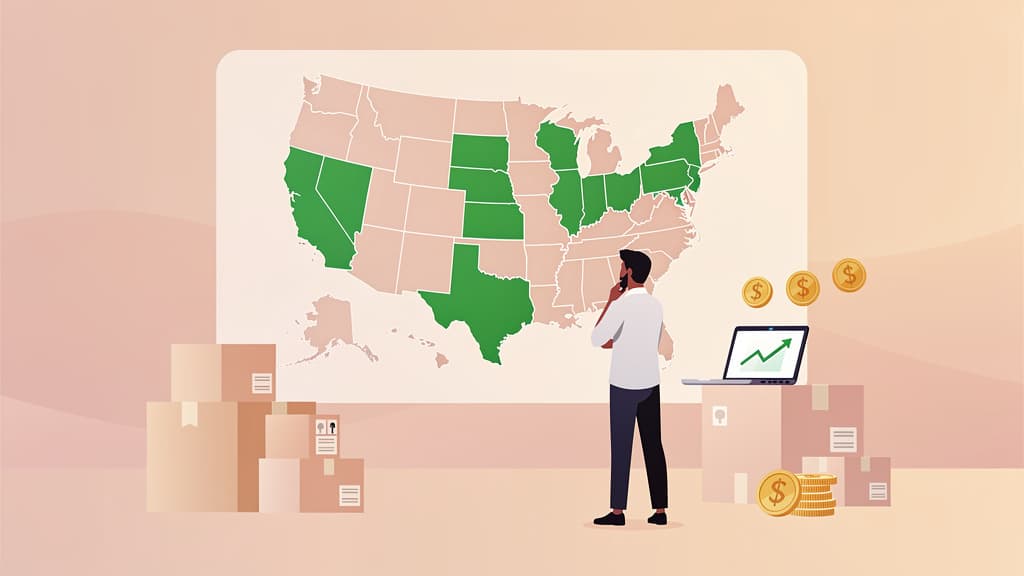
Nine states charge no tax on individual income in 2026: Alaska, Florida, Nevada, New Hampshire, South Dakota, Tennessee, Texas, Washington, and Wyoming (Tax Foundation, 2026 state income tax rates). "No income tax" does not mean no taxes: Washington taxes long-term capital gains at 7-9.9%, Texas and Tennessee levy franchise taxes on businesses, and New Hampshire taxes business profits at 7.5%. And if you earn income in other states, those states can still tax it.
Key takeaways:
- The nine no-income-tax states are Alaska, Florida, Nevada, New Hampshire, South Dakota, Tennessee, Texas, Washington, and Wyoming. New Hampshire completed the list by repealing its Interest & Dividends Tax on January 1, 2025
- Florida, Nevada, and Texas ban a personal income tax in their state constitutions; repeal would require a voter-approved amendment
- Washington is the exception to watch: no income tax on wages, but a 7% capital gains tax on long-term gains above $278,000 (2025 deduction amount), rising to 9.9% above $1 million
- For a freelancer with $150,000 of taxable income, moving from California to any of these states saves roughly $10,500 per year in state income tax
- Nexus rules follow the work: income you physically earn in another state is taxable there, no matter where you live

Save this map — the nine no-income-tax states in one image.
| State | Income Tax | State Sales Tax | Key Business Tax |
|---|
| Alaska | None | None (local only) | Corporate income tax (2%-9.4%) |
| Florida | None (constitutional ban) | 6% | Corporate income tax (5.5%, C-corps only) |
| Nevada | None (constitutional ban) | 6.85% | Commerce Tax (gross revenue over $4M) |
| New Hampshire | None | None | Business Profits Tax (7.5%) |
| South Dakota | None | 4.2% (through June 2027) | None |
| Tennessee | None | 7% | Franchise & excise tax |
| Texas | None (constitutional ban) | 6.25% | Franchise tax (0.375%-0.75% above $2.65M revenue) |
| Washington | None | 6.5% | B&O tax + capital gains tax (7%-9.9%) |
| Wyoming | None | 4% | None |
Key points:
- New Hampshire fully repealed its Interest & Dividends Tax as of January 1, 2025
- "No income tax" applies to individual income; most of these states tax businesses differently
- State nexus rules mean you may owe income tax to other states where you earn income
- LLC formation state and personal residence state are separate decisions
- Federal taxes remain identical in all 50 states
Income tax: None (Alaska repealed its individual income tax in 1980)
Sales tax: No state sales tax, but municipalities can levy local sales taxes (typically 1%-7.5%)
Property tax: Varies by borough, averaging around 1.19% of assessed value
Other business taxes: Corporate income tax of 2%-9.4% on Alaska-sourced C-corp income
Best for: Remote workers and sole proprietors who don't operate a corporation. Freelancers with no physical presence in other states benefit the most.
Watch out for: Alaska's corporate income tax applies to C-corps earning income in Alaska. Pass-through entities (sole proprietorships, LLCs, S-corps) are not subject to it. The state also has no individual capital gains tax.
Cost of living factor: Alaska has a high cost of living, particularly for goods and housing outside Anchorage. The state pays residents an annual Permanent Fund Dividend ($1,000 for 2025, set by House Bill 53) that partially offsets costs.
Income tax: None. The ban is constitutional: Article VII, Section 5 of the Florida Constitution prohibits a state tax on the income of natural persons
Sales tax: 6% state + up to 2% local (effective rates often 7%-7.5%)
Property tax: Average effective rate around 0.86%
Other business taxes: 5.5% corporate income tax on C-corp income; pass-through entities pay none
Best for: Self-employed individuals, freelancers, and LLC owners. Florida is the most popular no-income-tax state for business relocation, with large entrepreneurial hubs in Miami, Tampa, and Orlando.
Watch out for: The homestead exemption cuts property tax for primary residences (up to $50,000 exempt), but rental and investment properties get no such benefit. Homeowner's and flood insurance costs can be substantial.
LLC formation: Florida charges a $138.75 annual report fee. Many owners form a Florida LLC while living elsewhere, but your operating state still controls where your income is taxed.
Income tax: None. Article 10, Section 1 of the Nevada Constitution states that no income tax shall be levied on the wages or personal income of natural persons; only a voter-approved amendment could change that
Sales tax: 6.85% state base + local additions up to about 1.53%
Property tax: Average effective rate around 0.55% (among the lowest nationally)
Other business taxes: Commerce Tax on businesses with Nevada gross revenue exceeding $4 million (rates 0.051%-0.331% by industry). Modified Business Tax (MBT) on employer payroll
Best for: Small business owners under $4M in revenue. Nevada combines no income tax with low property taxes and no franchise tax for small businesses.
Watch out for: The Commerce Tax only touches larger businesses, so most freelancers and solopreneurs never encounter it. The MBT matters once you hire: general businesses pay 1.17% on quarterly wages above $50,000 (Nevada Department of Taxation; financial institutions pay 1.554% from the first dollar).
Income tax: None. The 3% Interest & Dividends Tax was fully repealed effective January 1, 2025, ahead of the originally planned 2027 date. New Hampshire residents now pay no state tax on wages or investment income
Sales tax: None
Property tax: One of the highest in the nation, averaging around 1.86%
Other business taxes: Business Profits Tax (BPT) at 7.5%; Business Enterprise Tax (BET) at 0.55% on the enterprise value tax base (wages, interest, and dividends paid)
Best for: Freelancers and remote workers who rent rather than own property. New Hampshire is the only state with no individual income tax AND no state or local sales tax.
Watch out for: The BPT (7.5%) applies to pass-through entities too. For taxable periods beginning in 2025 or later, any business with more than $109,000 in gross business income must file a BPT return, and BET filing starts at $298,000 of gross receipts or enterprise value (thresholds adjust biennially). The BPT works like an income tax on your business profits, so don't assume "no income tax" leaves business income untouched in NH.
Income tax: None
Sales tax: 4.2% state + up to 2% municipal. The 4.2% rate is temporary: it reverts to 4.5% on July 1, 2027 unless the legislature extends it
Property tax: Average effective rate around 1.08%
Other business taxes: No corporate income tax, no business income tax, no personal property tax
Best for: Business owners who want the lowest total business tax burden. South Dakota is also a popular state for trust formation.
Watch out for: South Dakota's economy is small, which means fewer local clients for service businesses. If your work is entirely remote, this doesn't matter.
Income tax: None (the Hall Income Tax on dividends and interest was fully repealed on January 1, 2021)
Sales tax: 7% state + up to 2.75% local, among the highest combined rates nationally
Property tax: Average effective rate around 0.64%
Other business taxes: Franchise tax of 0.25% of Tennessee net worth (minimum $100; the alternative property measure was repealed in 2024), plus excise tax of 6.5% on net earnings after a $50,000 deduction
Best for: Service-based freelancers who don't purchase much taxable equipment or inventory; sole proprietors, who are generally exempt from franchise and excise taxes.
Watch out for: The franchise and excise taxes apply to LLCs and corporations doing business in Tennessee. The 6.5% excise tax is effectively a business income tax by another name. Sole proprietors are generally exempt, but LLCs are not. Check whether your entity structure triggers these taxes before assuming Tennessee is tax-free for your business.
Income tax: None, and constitutionally prohibited: Proposition 4 (2019) added Article 8, Section 24-a to the Texas Constitution, banning an individual income tax outright
Sales tax: 6.25% state + up to 2% local (max combined 8.25%)
Property tax: Among the highest nationally, averaging around 1.68%
Other business taxes: Franchise ("margin") tax of 0.75% for most businesses, 0.375% for retail/wholesale. No-tax-due threshold: $2.65 million in annual revenue for 2026-2027 reports (up from $2.47 million for 2024-2025, per Texas Comptroller inflation adjustment)
Best for: Most small business owners and freelancers. The constitutional ban is the strongest guarantee against future change, and the $2.65M threshold means the vast majority of small businesses pay zero state business tax; below the threshold you no longer even file a No Tax Due report, just the free Public Information Report. Details in our Texas franchise tax guide.
Watch out for: Property taxes. A $500,000 Texas home generates roughly $8,400-$12,500 in annual property taxes, more than in most income-tax states.
LLC formation: Texas charges a $300 formation fee and no annual report fee.
Income tax: None on wages and business income
Sales tax: 6.5% state + local rates that push combined rates above 10% in the Seattle area
Property tax: Average effective rate around 0.94%
Other business taxes: Business & Occupation (B&O) tax on gross receipts, plus a capital gains tax (7%-9.9%)
B&O rates that matter (Washington Department of Revenue, effective October 1, 2025): retailing 0.471%; wholesaling and manufacturing 0.484%; Service and Other Activities 1.5% for businesses with under $1 million of gross income, 1.75% from $1 million to $5 million, and 2.1% at $5 million or more.
Watch out for: The B&O tax hits gross receipts with no deduction for expenses. A consultant with $500,000 in revenue and $400,000 in expenses still pays B&O on the full $500,000. At the 1.5% service rate, that's $7,500, profitable year or not.
Capital gains alert: Washington taxes long-term capital gains at 7% above the standard deduction ($278,000 for 2025, inflation-adjusted annually) and 9.9% on gains exceeding $1 million (the 2.9% surcharge came from SB 5813, retroactive to January 1, 2025). Real estate, retirement accounts, and certain business sales are exempt. The state supreme court upheld the tax as an excise tax in Quinn v. Washington (2023). Model a sale first with our capital gains tax calculator.
Income tax: None
Sales tax: 4% state + up to 2% county
Property tax: Average effective rate around 0.55%
Other business taxes: No corporate income tax, minimal business licensing fees
Best for: Business owners who want the simplest, lowest-tax state overall: no income tax, no corporate tax, low property and sales taxes, plus strong LLC privacy laws.
Watch out for: Wyoming has a small population and economy. For fully remote businesses this concern doesn't apply.
The savings from relocating depend on what you're leaving. The 2026 top marginal rates in the highest-tax jurisdictions, per the Tax Foundation:
| Jurisdiction | Top marginal rate (2026) | Applies above |
|---|
| California | 13.3% (12.3% + 1% mental health services surcharge) | $1 million |
| New York State | 10.9% (nine brackets starting at 4%) | $25 million |
| New York City (added to state tax for residents) | 3.078%-3.876% | 3.876% at the top city bracket |
A New York City resident at the top of both schedules faces a combined state-plus-city marginal rate near 14.8%. More practically: a single California freelancer with $150,000 of taxable income pays roughly $10,500 in state income tax under the 2026 brackets (most of it at the 9.3% marginal rate), while the same freelancer in Texas, Florida, or Nevada pays $0. Federal tax, including quarterly estimated payments, stays exactly the same in every state.
Tax nexus is the legal connection between your business and a state that gives that state the right to tax you. Even if you live in a no-income-tax state, you may owe income tax to other states where you have nexus.
You may have income tax obligations in another state if you:
- Travel to a state for work: working in a state beyond a day-count threshold (varies by state) triggers filing obligations
- Have a physical office or co-working space in another state: physical presence is the strongest form of nexus
- Hire employees or contractors in another state: payroll can create nexus
- Sell products into a state: after South Dakota v. Wayfair (2018), economic nexus rules (commonly $100,000 in sales) apply to remote sellers
- Serve clients in a convenience-rule state: New York and Connecticut may tax remote workers whose employer is based there, even for days worked elsewhere
Scenario 1: Florida resident, New York clients. You consult for New York companies. If you work from their New York offices, New York taxes the income earned on those days. If you work entirely from Florida as an independent contractor, New York generally cannot tax you, but W-2 remote employees of NY employers can be caught by the "convenience of the employer" rule.
Scenario 2: Texas resident, California project. A 3-month on-site contract in California is California-source income, taxed on a nonresident return (Form 540NR), regardless of your Texas residency.
Scenario 3: Wyoming resident, clients in ten states. A freelance writer performing all work from Wyoming is taxable only where the work happens: Wyoming, which charges nothing. Client locations alone don't create income tax nexus for services performed remotely.
| State | Approach |
|---|
| New York | "Convenience of the employer" rule; may tax remote W-2 workers |
| California | Taxes all CA-source income of nonresidents; aggressive enforcement |
| Connecticut | Convenience rule similar to New York |
| New Jersey | Reciprocal agreements with some states, aggressive with others |
Bottom line: living in a no-income-tax state protects you from your home state's taxes. It doesn't protect income you physically earn somewhere else.
Personal residence state determines which state can tax your personal income. LLC formation state determines which state's laws govern your LLC's structure and legal protections. Compare options side by side with the best state to form an LLC tool.
Many freelancers form the LLC in Wyoming or Delaware (privacy, asset protection) while living in a no-income-tax state. Caveats:
- You must register as a foreign LLC in your operating state. A Wyoming LLC operated from Texas needs Texas foreign registration, and you pay fees in both states
- Your residence state taxes your income regardless of formation state. Forming in Wyoming doesn't make you a Wyoming taxpayer
- Formation state affects legal protections, not taxes
- Privacy: Wyoming and New Mexico don't require public disclosure of LLC members
- Asset protection: Wyoming has strong charging-order protections
- Investor expectations: Delaware's Court of Chancery and settled case law
- Otherwise: if you live and work in one state, forming locally is usually cheapest; the LLC tax benefits guide covers what an LLC does and doesn't change
High-tax states challenge departures. To establish domicile in your new state:
California: the Franchise Tax Board runs aggressive departure audits, examining cell phone records, credit card transactions, and travel patterns. New York: the Department of Taxation and Finance audits where you keep a "permanent place of abode" and counts your days. New Jersey, Connecticut, Minnesota also scrutinize nonresidence claims.
Most states use a 183-day test, and in most of them any part of a day counts as a full day. Travel days may or may not count depending on the state. Contemporaneous records decide these audits.
- Performing services in another state: even a few days of on-site work can trigger a nonresident filing requirement
- Rental income: property in another state requires filing there
- Partnership or S-corp income: pass-through entities with multi-state operations can create filing duties in each nexus state
- Selling goods: economic nexus (commonly $100,000 in sales) triggers sales tax registration
Take a Texas resident with $200,000 of income who worked on-site in California and New York during the year:
| Return | Income taxed | Result |
|---|
| Texas | None (no state income tax return exists) | $0 |
| California nonresident (Form 540NR) | $40,000 of CA-source income (two months on-site) | ~$3,200 |
| New York nonresident (Form IT-203) | $25,000 of NY-source income | ~$1,500 |
| Federal Form 1040 | All $200,000, same in every state | unchanged |
Residents of income-tax states get a home-state credit for taxes paid to other states. Residents of no-income-tax states don't need one: you pay other states only on income actually sourced there, and your home state charges nothing on the rest.
Immediate cash flow. State income taxes run roughly 3%-13.3%. On $150,000 of income, that's $4,500-$15,000 a year that stays with you. At Anna Money we served 60,000+ UK businesses under one national tax schedule; the biggest US-specific lever I found after moving here is that your state choice alone can swing five figures a year.
Simpler filing. No state return means less paperwork and lower prep costs (federal quarterly estimates still apply).
Attracting talent. No state withholding means higher take-home pay for the same gross salary.
Higher property taxes. Texas (≈1.68% average) and New Hampshire (≈1.86%) backfill with property tax.
Higher sales taxes. Tennessee's combined rates reach 9.75%; Washington's exceed 10% in the Seattle area.
Business taxes by other names. Washington's B&O (1.5%-2.1% on service gross receipts), Texas's franchise tax, Tennessee's 6.5% excise tax, and New Hampshire's 7.5% BPT all tax business activity without being called income taxes.
Fewer public services and lifestyle trade-offs. Budget structures differ, and Alaska's isolation or Wyoming's sparseness matter more than any tax rate if they don't fit your life.
Problem: A consultant relocates to Washington expecting zero state tax, then meets the B&O tax and the capital gains tax.
Impact: A service business with $300,000 in gross receipts owes $4,500 in B&O tax (1.5% service rate). Selling stock with $400,000 of long-term gains triggers 7% on the $122,000 above the $278,000 deduction: $8,540.
Solution: Price in ALL state and local taxes before moving: sales, property, gross receipts, excise, and capital gains.
Problem: A California freelancer forms a Wyoming LLC while continuing to live and work in California.
Impact: California taxes residents on all income regardless of where the LLC is formed, plus the $800 annual California LLC franchise tax and Wyoming fees, with zero income tax savings.
Solution: Residence and work location determine income tax. The LLC's state doesn't.
Problem: A New York consultant "moves" to Florida but keeps a Manhattan co-op, votes in New York, and spends 150+ days a year there.
Impact: A New York residency audit unwinds the move: back taxes, penalties, and interest on every year of claimed Florida residency.
Solution: Work the full domicile checklist and keep a day log. Half-moves fail audits.
Problem: A Texas consultant works on-site for clients in California, Illinois, and New York without tracking days or filing nonresident returns.
Impact: Each state can assess tax on the days worked there, plus failure-to-file penalties. California's Form 540NR obligation doesn't disappear because your home state has no return.
Solution: Track days per state, file nonresident returns where required, and price on-site work accordingly.
State planning only works if you know where every dollar came from. Jupid is an AI accountant in WhatsApp and iMessage: connect your bank account and it categorizes every transaction with 95.9% accuracy, tagging income by client and source so nonresident-state allocations stop being an April archaeology project. Ask "how much did the California project pay me this year?" or "what's my estimated federal tax?" and you get an answer in chat, computed from your live numbers. Federal obligations follow you into every state, income tax or not. Try Jupid.
- Tax Foundation: 2026 State Income Tax Rates and Brackets
- Florida Constitution, Art. VII, §5: personal income tax prohibition
- Nevada Constitution, Art. 10, §1: no tax on wages or personal income of natural persons
- Texas Constitution, Art. 8, §24-a: individual income tax ban (Proposition 4, 2019)
- South Dakota v. Wayfair, Inc. (2018): economic nexus for sales tax
- Quinn v. Washington (2023): capital gains tax upheld as an excise tax
| Item | Amount |
|---|
| Federal standard deduction (single / MFJ) | $16,100 / $32,200 (Rev. Proc. 2025-32) |
| Self-employment tax rate | 15.3% |
| QBI deduction | 20% of qualified business income |
| TX franchise tax no-tax-due threshold (2026-2027 reports) | $2,650,000 |
| WA capital gains tax | 7% (up to $1M) / 9.9% (over $1M) |
| WA capital gains standard deduction (2025) | $278,000 |
| WA B&O service rate | 1.5% (under $1M gross) / 1.75% / 2.1% |
| NH Business Profits Tax / Business Enterprise Tax | 7.5% / 0.55% |
| TN excise tax | 6.5% of net earnings (after $50,000 deduction) |
| SD state sales tax | 4.2% (reverts to 4.5% on July 1, 2027) |
Living in a no-income-tax state is a legitimate, powerful strategy: a self-employed person earning $150,000 saves roughly $7,500-$15,000 a year versus a high-tax state. Three principles keep the strategy intact:
- Compare total tax burden, not just income tax. Texas backfills with property tax, Washington with B&O and capital gains tax, Tennessee with sales and excise taxes. Run your specific numbers.
- Nexus follows the work. Income physically earned in California or New York is taxable there regardless of your address. Track days, file nonresident returns.
- Domicile must be real. A documented, genuine move survives an audit; a mailbox move does not.
Disclaimer
This article provides general information about state income taxes and should not be considered tax or legal advice. State tax laws, rates, and nexus rules change frequently and vary significantly between jurisdictions. Multi-state tax situations are particularly fact-specific. Your actual tax obligations depend on your domicile, income sources, business structure, and activities in each state. For advice specific to your situation, consult with a qualified tax professional familiar with the relevant states.
Tax Year: 2026
Last Updated: July 7, 2026